
Key Points
- Mixed signals, concentrated gains. U.S. equities held strong in Q3, but gains narrowed to fewer stocks and rising rates weighed on fixed income.
- Tricks, treats, and reasons for caution. Elevated valuations, inflation, and geopolitical risks remain, balanced by strong earnings, AI investment, and more attractive fixed-income yields.
- Contrarian investments bearing fruit. Earlier investments in venture capital, biotech, natural resources, reinsurance, and emerging market debt are paying off. We've taken some gains while remaining constructive on many of these opportunities.
- Discipline through every market cycle. We remain focused on diversification and building durable portfolios designed to fund our clients' missions for the long term.
Fall is typically a time for admiring changes in nature, for football, and, of course, for Halloween. Each October, trick-or-treaters approach a neighbor’s door without knowing exactly what awaits them. Investors might recognize the feeling.
Markets currently offer plenty of reasons for optimism. Corporate earnings remain strong, the economy has shown resilience, artificial intelligence (AI) continues to drive significant investment, and higher interest rates have restored meaningful income to fixed income. On the other hand, elevated equity valuations, narrow market leadership, persistent inflation, fiscal concerns, and geopolitical uncertainty leave plenty of reasons for caution.
Of course, investing is rarely as simple as separating the tricks from the treats. Some of today’s most promising developments also contain risks, while some of the market’s biggest challenges are creating new opportunities. This quarter, we consider that duality, while also reflecting on how the natural abundance of the fall harvest season is typically celebrated as the culmination of a long period of hard work. At Verger, we know that successful investing requires patience through periods when ideas may be overlooked, out of favor, or simply taking longer than expected to bear fruit.
Market Review
What Lurks Beneath
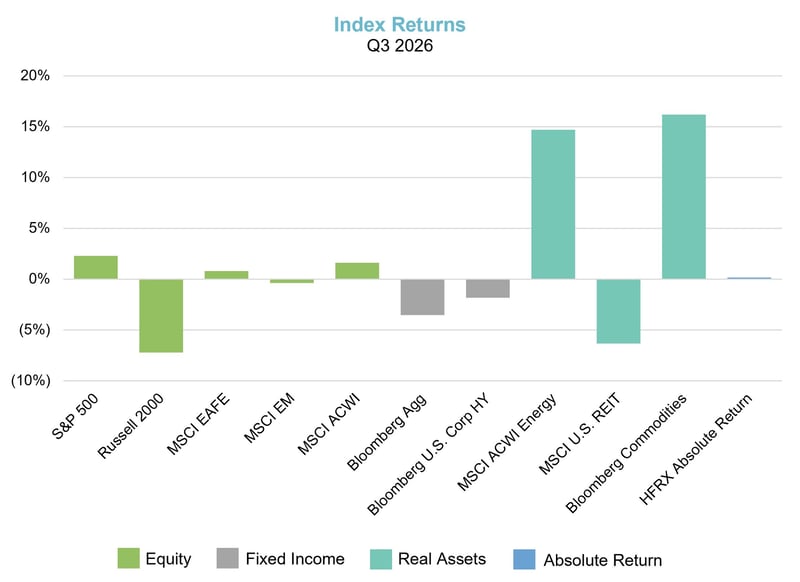
During the third quarter, markets delivered something of a mixed bag. U.S. equities continued to advance, with the S&P 500 gaining about 2%. But this headline return masked considerably more weakness beneath the surface. The equal-weighted S&P 500 declined approximately 2%, the Dow fell more than 2%, and small-cap stocks (as represented by the Russell 2000) dropped roughly 7%. In fact, by quarter-end more than 60% of S&P 500 companies were trading below their 200-day moving averages, despite the index itself remaining close to an all-time high. Put differently, the market continued to rise, but fewer stocks were doing the lifting.
AI remained an important part of this story. Investor enthusiasm around AI, continued infrastructure investment, and strong corporate earnings helped support many of the market's largest companies, even as rising interest rates created a more difficult backdrop for equities broadly. This continues a theme we have been watching for some time. Last year, we highlighted just how much of U.S. equity returns, earnings growth, and capital spending had become connected to a relatively small group of AI-related companies. We pointed out that developments in AI increasingly matter not just to technology investors, but to the entire market. We believe this remains true.
The bigger scare during the quarter arguably came from the bond market. Inflation remained stubborn, energy prices moved higher, and investors increasingly considered the staying power of restrictive monetary policy. The 10-year Treasury yield rose from roughly 4.5% at the beginning of the quarter to more than 5.2% by quarter-end, driving the Bloomberg U.S. Aggregate Bond Index down approximately 3.5%. The movement reflected more than just near-term inflation concerns: higher real rates, fiscal deficits, and heavy government borrowing also contributed to pressure on global bond markets.
Commodities (as represented by the Bloomberg Commodity Index) provided a very different experience, rising approximately 16% during the quarter. Energy was an important driver as renewed Middle East tensions rebuilt the geopolitical risk premium in oil and gas markets, with Brent crude moving back above $100 per barrel during the quarter.
Taken together, the quarter presented an unusual juxtaposition: equity indices hovering near record levels, increasingly narrow market leadership, a meaningful selloff in bonds, and sharply higher commodity prices. None of those developments independently results in a bearish conclusion, particularly against a backdrop of resilient economic growth and strong corporate earnings. But together, they can reinforce something we have written about frequently: appealing headline returns can sometimes obscure important changes beneath the surface.
Source: Bloomberg
Market Outlook
Trick or Treat?
As we’ve mentioned, things are a bit more complicated than separating the spooky from the sweet. At a high level, however, we see the following notable bites as key risks and opportunities to watch.
Trick: Valuations & rates
The 10-year Treasury yield rose from roughly 4.5% at the beginning of the quarter to more than 5.2% at quarter-end, reaching levels not seen since 2002. Meanwhile, U.S. equities remain expensive. This combination of high U.S. equity valuations and higher interest rates is perhaps the most obvious risk.
Inflation has remained sticky, with the Fed's preferred PCE measure rising 3.4% year over year in August and core inflation increasing 3.0%. Higher energy prices and geopolitical uncertainty in the Middle East have complicated that picture further. As we saw earlier this year, events involving Iran and the Strait of Hormuz can quickly flow through to oil prices, inflation expectations, and ultimately interest-rate expectations.
Fiscal imbalances across many countries are becoming harder to ignore. In the U.S., net federal interest costs were estimated at approximately $1.1 trillion for fiscal 2026, and yields above 5% have renewed concerns about the feedback loop between higher borrowing costs and rising government debt. Persistent deficits and growing interest expense represent one more reason investors may demand greater compensation for lending to governments. This matters because sovereign yields ultimately influence required returns, borrowing costs, and asset valuations throughout the capital markets.
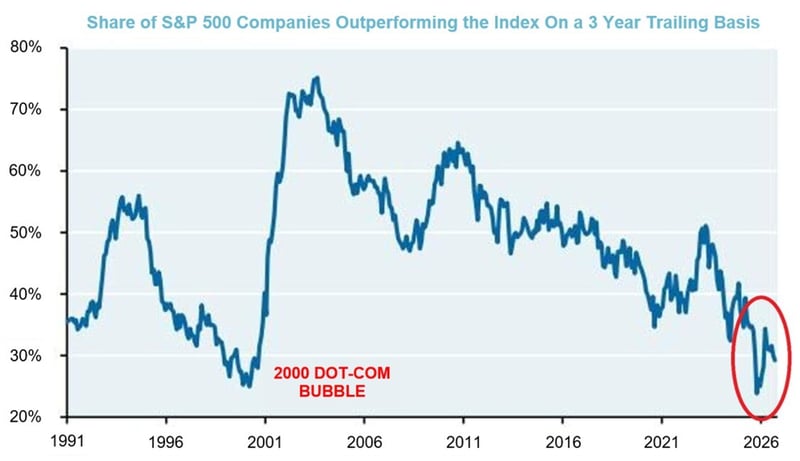
U.S. equity returns are increasingly dependent on a relatively small group of companies. The percentage of companies outperforming the index on a trailing three-year basis is near 35 year lows (as shown in the chart below). This may indicate that there is only limited room for disappointment should earnings or economic growth fail to meet elevated expectations.
Source: Bloomberg, JPMAM
Trick: Higher financing costs
We continue to watch for signs that higher financing costs are beginning to expose weaker balance sheets. In addition, parts of the AI ecosystem merit particular attention as enormous capital requirements are increasingly intersected with debt markets. This serves as an important reminder that even compelling long-term growth stories can become vulnerable when expectations, leverage, and financing requirements all rise together. Extraordinary innovation does not necessarily translate into a compelling investment without an attractive price or capital structure.
Treat: Corporate earnings and economic resilience
Corporate earnings have been remarkably strong. In the second quarter, 86% of S&P 500 companies beat earnings estimates, providing fundamental support for equity market levels despite higher rates and macroeconomic uncertainty. Strong markets supported by growing earnings are different from markets driven solely by multiple expansion, and continued earnings growth could help today's elevated valuations become more reasonable over time.
The economy itself has continued to show resilience despite considerable uncertainty. Economic growth has persisted against a backdrop of higher rates, persistent inflation, and geopolitical tensions.
Treat: AI demand
Investment in AI-related infrastructure remains significant, supporting demand for semiconductors, data centers, power, and a wide range of related infrastructure. Q3 continued to feature robust AI-related demand and capital spending. In our continuing view, the critical question is not whether AI will create value, but who will ultimately capture that value, and what price investors should be willing to pay for it.
Treat: Higher rates
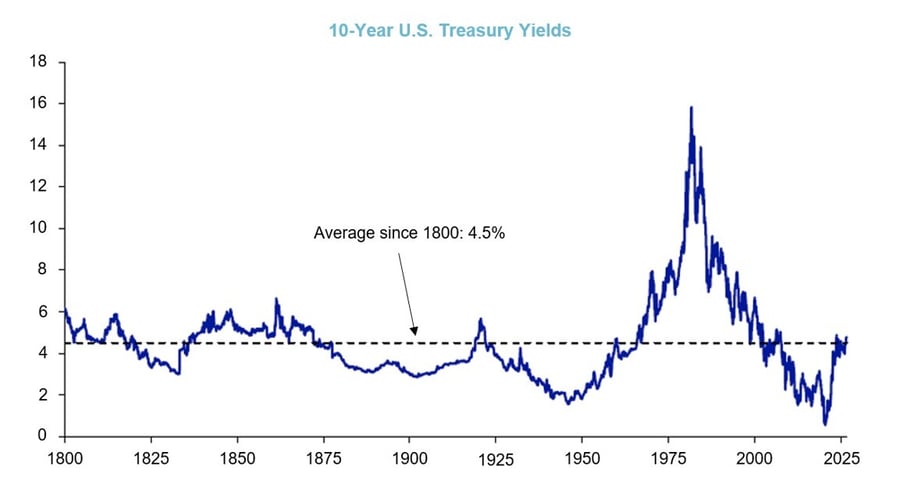
Higher interest rates also have a sweeter side. While the rise in yields has produced painful mark-to-market losses for bond investors, it has simultaneously improved prospective returns on newly invested capital. With the 10-year Treasury above 5% around quarter-end, investors can now earn levels of income from high-quality fixed income that have been largely unavailable for much of the post-financial-crisis period. That creates a much more interesting opportunity set across fixed income – unless we happen to be entering a higher inflationary period similar to the late 70s/early 80s, as shown in the chart below. We continue to question whether long-duration Treasuries will provide the same diversification benefit during equity selloffs that they have provided in prior decades. However, the higher income now available is undoubtedly a more attractive starting point.
Sources: Finaeon, Deutsche Bank
Treat: Uneven markets
For diversified, active investors, the significant dispersion underneath headline markets may offer another treat. Capital is plentiful in some corners of the market and scarce in others; expectations are extremely optimistic for certain assets and deeply pessimistic for others. We believe that kind of environment can reward selectivity and disciplined underwriting.
Market Opportunities
So, is today's market offering investors a trick or a treat? Probably some of both. The bullish case deserves to be taken seriously: earnings are strong, AI investment is substantial, the economy remains resilient, and fixed-income investors can once again earn attractive yields. But the risks are equally difficult to dismiss. Markets are expensive and concentrated, inflation is still elevated, borrowing costs have risen sharply, fiscal pressures are building, and geopolitical risks remain meaningful. Rather than trying to guess which side ultimately fills more of the bucket, we believe the better approach is to build a resilient and durable portfolio capable of handling both.
Harvest Season
As part of Verger’s disciplined investment process, we plant seeds where valuations are attractive, capital is scarce, or investor expectations appear unduly pessimistic. In the past few years, these areas have included venture capital, biotechnology, natural resources, reinsurance, and emerging market debt. For example, in previous commentaries, we’ve highlighted natural resources as an increasingly compelling opportunity after years of underinvestment and pointed to biotechnology as appealing to us because of attractive valuations, differentiated return drivers, and an environment where specialized managers can capitalize on significant dispersion.
Recently, some of the aforementioned investments have begun to bear fruit, and we have harvested a portion of the gains. Importantly, harvesting does not necessarily mean that we believe the opportunity to be over. In many cases, we continue to like the fundamental setup of these opportunities and maintain meaningful exposure. Rather, disciplined portfolio management sometimes means trimming a successful investment as valuations rise, risks change, or weight in the portfolio grows. Just as a farmer does not leave a ripe crop indefinitely in the field, we believe investors should be willing to realize some gains when the circumstances warrant, while retaining exposure to opportunities that continue to offer attractive long-term potential.
Closing Thoughts
Preparing for Every Season
Instead of trying to predict the next trick or chase the latest treat, we believe long-horizon investors should prepare for a wide range of outcomes. Thoughtful diversification, careful liquidity management, and disciplined underwriting provide a stronger foundation than relying on any single economic forecast or market narrative. We believe that progress, especially for long-horizon institutions, should be evaluated across market cycles, or seasons, rather than through the lens of any single quarter or harvest.
Some seeds planted years ago are just now producing attractive results, while others remain in earlier stages of growth and will require continued patience. Again, portfolio diversification, thoughtful governance, liquidity management, and disciplined risk management are all key to our approach. As always, our goal is to cultivate a durable portfolio capable of supporting our clients’ missions through the many varied seasons to come.
All investments involve risk, including possible loss of principal.
Not all strategies are appropriate for all investors. There is no guarantee that any particular asset allocation or mix of strategies will meet your investment objectives. Diversification does not ensure a profit or protect against a loss.
One cannot invest directly in an index, and unmanaged indices do not incur fees and expenses.
This article is being provided for informational purposes only and constitutes neither an offer to sell nor a solicitation of an offer to buy securities. Offerings of securities are only made by delivery of the prospectus or confidential offering materials of the relevant fund or pool, which describe certain risks related to an investment in the securities and which qualify in their entirety the information set forth herein. Statements made herein may be materially different from those in the prospectus or confidential offering materials of a fund or pool.
This article is not investment or tax advice and should not be relied on as such. Verger Capital Management (“Verger”) specifically disclaims any duty to update this article. Opinions expressed herein are those of Verger and are not a recommendation to buy or sell any securities.
This article may contain forward-looking statements relating to future events. In some cases, you can identify forward-looking statements by terminology such as “may,” “will,” “should,” “expect,” “anticipate,” “believe,” “potential,” or “continue,” the negative of such terms or other comparable terminology. Although Verger believes the expectations reflected in the forward-looking statements are reasonable, future results cannot be guaranteed. Except where otherwise indicated, all of the information provided herein is based on matters as they exist as of the date of preparation and not as of any future date and will not be updated or otherwise revised to reflect information that subsequently becomes available, or circumstances existing or changes occurring after the date hereof.
References to indexes and benchmarks are hypothetical illustrations of aggregate returns and do not reflect the performance of any actual investment. Investors cannot invest in an index and do not reflect the deduction of the advisor's fees or other trading expenses.